Season 30 has reshaped how high-level players approach movement, positioning, and ranked fights. Axle sits at the center of that shift. She is a Skirmisher built around momentum, controlled sliding, rapid repositioning, and forced enemy displacement. This complete guide covers her abilities, the full set of Season 30 balance changes, ranked decision-making, weapon pairings, team compositions, and the practical techniques that separate flashy movement from consistent ranked progress.
If you’re new to the ladder itself, our guide to how Apex ranked works covers tiers, RP and entry costs before you take Axle into ranked.
Axle Playstyle at a Glance
Axle is a high-mobility Skirmisher designed to create openings through movement and displacement. In Season 30 her Nitro Gate and Kickstart received multiple balance adjustments that reward deliberate timing over pure aggression. The core rule is simple and non-negotiable: movement should create a measurable advantage, not simply look impressive.
What Makes Axle Important in Apex Season 30?
Axle arrived in Season 29: Overclocked, a season that placed heavy emphasis on movement and momentum. Respawn designed her around a clear philosophy: movement is more than traveling faster. It is a toolbox for influencing fights, controlling space, and forcing opponents into decisions they would rather not make. That design intent still defines her value in Season 30.
Her kit gives players multiple levers for manipulating the pace of an engagement. Drift improves control while sliding so that movement itself becomes part of the gunfight. Nitro Gate creates accelerated routes for closing distance, escaping, or rotating. Kickstart delivers enemy disruption and forced displacement. Her Skirmisher passive and upgrade options further support aggressive rotations and flexible repositioning.
The practical result is a Legend who can affect both sides of a fight. She can help the squad start an engagement or help it escape one. She can open a route toward an enemy or create a clean path away from danger. She can force opponents to react to movement they did not choose. That flexibility is exactly why serious ranked players invest time in learning her.
In the current meta, raw mechanical speed is no longer enough. Season 30 balance changes have raised the cost of careless ability use. The players who climb with Axle are the ones who treat every Nitro Gate and every Kickstart as a resource that must buy a concrete advantage: a better angle, a safer rotation, forced displacement, or a clear path for the squad to follow. She was still the most-picked Legend among top Predator players in late August, even after the launch nerf. After the 25 August and 1 October nerfs her Split 2 pick rate among Master and Predator players fell to 5.2%, and she now sits in A tier in our Season 30 ranked tier list.
Axle in Season 30: Full Balance Overview
Understanding the current version of Axle is essential before diving into advanced mechanics. Several targeted balance changes arrived during Season 30 specifically to increase counterplay and make her strongest tools more deliberate.
At the start of the season, the maximum Nitro Gate slide-boost duration dropped from five seconds to three seconds. Kickstart was also adjusted so that Axle herself could be affected by the ability, while allies could be stunned and displaced without taking damage. These changes alone shifted the feel of her kit toward careful timing.
The August 25 hotfix applied further reductions:
- Nitro Gate launch speed reduced from 750 to 700
- Kickstart health lowered from 200 to 150
- Kickstart base cooldown increased from 90 seconds to 120 seconds
- Kickstart stun duration cut from 1.5 seconds to 0.25 seconds, with a wider knockback arc and lower maximum height
- Jump Gate replaced by Drone Deployer, which restores the Ultimate cooldown to 90 seconds
These numbers matter because they change how Axle should be played. The older habit of treating every ability as an automatic invitation to push is less reliable. Modern Axle gameplay rewards players who create an advantage first and only then spend mobility resources to convert it. Timing, spacing, and follow-up potential now sit at the center of every high-value play.
Axle was not the only legend touched; our patch notes list every Season 30 balance change.
The 1 October update
Respawn nerfed Axle again in the 1 October 2026 update, aimed at how hard she is to track mid-slide:
- Drift: sliding lateral control cut by 50%, so holding momentum through tight corners is harder.
- Nitro Gate: lateral control while boosted cut by 25%, and the initial push speed lowered from 700 to 650.
- Nitro Gate: aim assist is disabled for players under its effect.
- Kickstart: maximum knock-up cut from 700 to 650, drone chase time from 10 to 8 seconds, and much less knock-up when the drone locks on straight after deployment.
The aim assist change matters most on controller: plan Nitro Gate as the move that gets you to cover or an off-angle, then take the fight from there instead of shooting while boosted. Her Master and Predator pick rate fell 45% in the week after the update and another 18% the week after, to 5.2% on 20 October (Apex Legends Status), so expect fewer mirror matchups and more Octane and Mad Maggie as the aggressive picks you meet.
Understanding Axle’s Playstyle
The most common early mistake is assuming that speed equals aggression. “Axle is fast, so I should always play aggressively” sounds logical, but it leads to overextension, isolated deaths, and lost ranked points. Axle’s movement creates opportunities. Whether those opportunities are worth taking is a separate decision.
Strong Axle players constantly run a short internal checklist:
- Where is my team right now?
- Where is the enemy team, and what are they watching?
- What concrete advantage does this movement create?
- What happens if the enemy survives the first contact?
If Nitro Gate drops you inside an enemy building while teammates are still eighty meters away, the movement succeeded but the play failed. If Kickstart displaces a target that nobody can see or shoot, the ability created noise without damage. If Drift lets you slide around cover, avoid incoming fire, and maintain pressure, the movement is doing exactly what it should.
Decision-making is the difference. Axle rewards players who treat mobility as a means to an end rather than the end itself. The best players look for situations where movement multiplies an existing advantage—shield crack, isolated target, favorable third-party timing—or solves a clear problem such as a dangerous rotation or a collapsing ring.
Axle’s Passive: Drift
Drift is the mechanical foundation of the entire kit. It improves control while sliding, allowing skilled players to use momentum more deliberately during combat. For most Legends, sliding is mainly a way to travel between positions. For Axle, sliding becomes part of the gunfight itself.
Why Drift Matters in Real Fights
A well-timed slide can accomplish several things at once:
- Reduce the time your hitbox is fully exposed
- Change direction without losing all momentum
- Make enemy tracking more difficult
- Move you around cover while still applying pressure
- Create an unexpected entry or exit angle
- Help you disengage cleanly after dealing damage
The key is selectivity. Continuous sliding looks flashy but often wastes the passive’s value and makes aim less consistent. Slide when the movement provides a clear benefit—new angle, safer path, broken line of sight—then return to stable gunplay.
Controlled Circular Movement
One of the highest-value concepts for Axle is controlled circular movement. Instead of always moving directly toward or away from an enemy, use Drift to curve around them or around nearby cover. The opponent is no longer tracking a simple forward-and-back pattern. They are tracking a player who can preserve momentum while changing the angle of approach.
Picture a fight near a large rock. A basic player moves toward the rock, shoots, then retreats along the same line. An experienced Axle player slides toward the rock, curves around the far side, maintains pressure, changes direction again, and re-enters from a different angle. That sequence forces constant re-acquisition and creates openings for teammates.
Controller-Specific Advice
Controller players should prioritize smooth movement over exaggerated stick inputs. While sliding, use the left stick to maintain a controlled direction and the right stick to keep the crosshair stable on the target. Avoid constant maximum-strength directional changes unless the situation truly requires them. Smooth, purposeful movement is far easier to combine with consistent aim.
A simple but effective practice routine:
- Load into the Firing Range
- Equip an SMG
- Practice sliding around a stationary dummy
- Keep the crosshair near chest height the entire time
- Change direction without losing tracking
- Repeat the same drill while using actual cover pieces
Mouse-and-Keyboard Approach
MnK players can combine precise A/D strafes with mouse tracking to create tight movement patterns. The advantage is fine directional control. The risk is adding unnecessary complexity. Do not insert extra movement simply because you can. If an enemy is already struggling to track a clean slide-and-strafe around cover, there is rarely a reason to layer on a more complicated sequence. Consistency beats flashy mechanics every time.
Drift and Hitbox Management
Sliding changes the character’s profile and can make tracking harder. Use that fact deliberately. A poor engagement looks like standing in the open, ADS-ing, trading damage, reloading, then retreating. A better Axle engagement looks like sliding into an angle, dealing damage, moving around cover, re-peeking from a second angle, and continuing pressure. The second approach forces the enemy to adjust repeatedly and creates clearer windows for the rest of the squad.
Nitro Gate: The Core Tactical Tool
Nitro Gate is the most important active tool in Axle’s kit. It accelerates movement and opens rapid repositioning options, yet the strongest uses are rarely the fastest ones. The best Nitro Gate is the one that creates the best position.
Treat the ability as a movement route rather than a pure “go faster” button. Valid purposes include closing distance after creating damage, escaping a collapsing fight, rotating early, taking an off-angle, helping teammates cross exposed ground, or changing the overall direction of an engagement.
Using Nitro Gate to Start a Fight
The classic high-percentage sequence is: create damage first, deploy Nitro Gate, close the gap, then finish the target. When a teammate cracks an enemy shield from mid-range, the shield crack is the real advantage. Nitro Gate simply converts that advantage into positional pressure before the opponent can heal.
The common mistake is reversing the order—gate first, then hope the enemy gets cracked. That sequence hands the enemy a free window to punish the entry. Whenever possible, generate a concrete reason to push before spending the mobility resource.
Nitro Gate for Flanking and Off-Angles
Straight-line pushes are predictable. If an enemy team is holding a doorway, a direct movement route toward that doorway makes tracking easier. Instead, ask where the enemy expects you to appear, then look for a Nitro Gate path that places you somewhere they are not watching.
A strong flank sequence might look like this: the enemy watches the front door, your teammates apply frontal pressure, Axle takes a side route, Nitro Gate accelerates the final approach, the enemy is forced to turn, and the rest of the squad gains a free shooting window. Good mobility does not simply make you faster—it increases the number of angles the enemy must defend simultaneously.
Nitro Gate for Rotations and Third Parties
Axle is not only a fighting Legend. Her movement value between fights is often higher than her in-fight value. Use Nitro Gate when the squad needs to beat the ring, cross open terrain, escape a third party, reach stronger ground, rotate around an enemy team, or move toward a late-game position.
The best rotation frequently prevents a fight rather than creating one. Ranked players sometimes assume every advantage must produce kills. That is not true. Reaching strong cover before another squad arrives is itself a measurable advantage. Nitro Gate is one of the cleanest tools for securing that timing.
Team Spacing: The Hidden Cost of Speed
Axle’s biggest team-play risk is her own speed. She can outrun teammates with ease, which creates the constant temptation to “just go.” Resist it. Before any aggressive gate, check the minimap and ask whether teammates currently have line of sight, weapons ready, full health and shields, a realistic path to follow, and the ability to support the fight. If the answer is no, the mobility has become overextension. A 1v3 remains a 1v3 even when you arrive first.
Kickstart: Using the Ultimate Correctly
Kickstart provides fight disruption through an enemy-seeking drone that stuns and displaces whoever it reaches. Season 30 changes have made careful usage far more important. The Ultimate now has lower health, a longer base cooldown, a much shorter stun and reduced knockback. Treat it as a high-value resource rather than a free button whenever it is available.
Ideal Kickstart Conditions
Strong opportunities usually share one or more of these traits:
- The target is isolated from teammates
- Your squad already has clear line of sight
- The enemy is holding a predictable or static position
- The enemy is already damaged or low on resources
- The enemy is trapped in a confined area with limited escape options
- Your teammates are ready and able to follow the displacement immediately
- The enemy is trying to reset behind cover
The best Kickstart is the one that creates an immediate follow-up window for the entire team. Displacement without damage or without follow-up is wasted value.
Space and Geometry Matter
Kickstart needs usable space to path correctly. Activating it while pressed against a wall or awkward geometry often produces little or no value. Always visualize the drone’s likely path before pressing the button. In close-range chaos, the first instinct may be to panic-ult. In many of those moments, simply shooting is the higher-percentage answer.
Coordination Multiplies Value
Displacement becomes dramatically stronger when the squad is prepared. Imagine an enemy holding cover. You launch Kickstart, the enemy is forced into a new position, and three teammates are already aiming at the landing zone. That is coordinated ability usage. The same Kickstart used while teammates are looting, healing, or fighting elsewhere often produces nothing. Communication—clear pings and short voice calls—turns Kickstart from a solo tool into a team-wide fight-winner.
Season 30 Upgrades Explained
Season 30 adjusted Axle’s upgrade structure. Automata was replaced by Long Haul, the upgrade order shifted, and Jump Gate was later replaced by Drone Deployer. Guides written for the launch version of Axle can therefore be outdated. Always verify the current patch before locking a ranked strategy around a specific perk.
Long Haul
Long Haul restores Nitro Gate’s maximum slide time to the previous five-second value. It is the natural choice for players who treat Axle primarily as a mobility and rotation specialist. The extended window helps when crossing large open areas, rotating with the full squad, creating longer flanks, escaping dangerous positions, or chaining multiple movement routes. Evaluate whether your actual games regularly need that extra duration. If most of your fights are short-range and close-quarters, another upgrade may deliver more practical value.
Sliding Shooter
Sliding Shooter rewards players who already combine movement and gunfire fluidly. It encourages a combat loop of slide → shoot → change angle → continue moving rather than the older pattern of slide → stop → shoot. The perk shines with close-range weapons and with players whose mechanical foundation is strong enough to keep accuracy high while moving. Without that foundation, the upgrade can encourage inaccurate spraying.
Drone Deployer
Drone Deployer returns Kickstart’s cooldown to the shorter 90-second value. More Ultimate uptime means more opportunities to create displacement and pressure across a match. The strategic value is straightforward, but the same discipline still applies: cooldown reduction does not justify careless usage. A player who wastes two Kickstarts still produces less value than a player who converts one into a clean knock and follow-up.
Weapon Pairings That Complement Mobility
Axle’s weapons should amplify her movement rather than fight against it. No single loadout wins every fight, yet certain categories fit her aggressive, close-to-mid-range style especially well.
SMGs
SMGs remain the most natural pairing. The CAR SMG, R-99, and Volt all allow continuous pressure while fighting at short range. The limiting factor is almost always crosshair placement. Excellent movement means little if the reticle sits below the target. Prioritize stable tracking during slides and direction changes.
Shotguns
Shotguns reward precise timing and positioning. A clean shotgun sequence with Axle often looks like approach → slide → peek → fire → immediately break line of sight. Standing still in front of an enemy while waiting for the next shot wastes the entire kit. Use Drift and Nitro Gate to control when the enemy gets another clean look at you.
Assault Rifles and Hybrid Loadouts
An Assault Rifle gives Axle meaningful mid-range options and creates a natural two-stage engagement. Stage one is mid-range pressure aimed at cracking shields or forcing the enemy off strong cover. Stage two is the mobility conversion—Nitro Gate or a well-timed slide to close distance. Stage three is the close-range finish with an SMG or shotgun. This hybrid approach is often more consistent in ranked than pure close-range loadouts because it lets you start fights from safer distances.
The Reliable Axle Fight Pattern
High-level Axle play rarely relies on improvisation alone. Most successful fights follow a repeatable five-step pattern that keeps mobility tied to concrete advantages.
- Identify the target — Know exactly who you are fighting and whether they are isolated before any commitment.
- Create damage — Look for a shield crack, a low-health target, or clear numerical advantage.
- Create movement — Use Nitro Gate or Drift to change distance or angle once the damage advantage exists.
- Collapse together — Move with the squad so that the fight remains a team fight rather than a solo duel.
- Reset and reassess — After the knock, check health, shields, ammo, teammate status, third-party risk, and the location of the next enemy. Do not automatically sprint toward the next target.
The final reset step is the one most often skipped in ranked. Winning a single fight does not mean the match is safe. Axle’s mobility is just as valuable for leaving a finished fight as it is for starting one.
Axle in Apex Legends Ranked
Ranked rewards more than mechanical skill. Placement, fight selection, team coordination, rotations, resource management, and consistency all matter. Axle can improve several of those areas, but she cannot replace sound decisions.
Early-Game Strategy
In the opening minutes, prioritize survival and information over aggression. An uncontested drop should focus on efficient looting, securing weapons, and identifying nearby squads before any fight is forced. A contested drop lets Axle use movement to reposition quickly between buildings and angles, yet the same rule applies: do not separate from teammates simply because you can move faster.
Mid-Game Strategy
Mid-game is where rotation potential becomes especially valuable. Once the squad is geared, begin thinking several zones ahead. Ask where the team actually wants to fight next. Instead of reacting to the ring at the last second, use Nitro Gate and Drift to establish strong positions early. Better cover, better sightlines, safer follow-up rotations, and clearer third-party options are all advantages that do not require a single kill.
Late-Game Strategy
Final circles leave far less room for error. Space shrinks, more teams remain, and third parties arrive faster. Small positional mistakes become immediately fatal. Use Axle to claim favorable terrain before the zone turns chaotic. When multiple squads are packed tightly, resist the urge to spend every ability. Save mobility for the moment when a single well-timed gate or Kickstart decides whether the team survives.
Third-Party Management
Many ranked games are decided in the seconds after a fight ends. You secure a knock, then another team arrives. Axle’s mobility gives the squad flexible responses: push the new threat, reset and heal, rotate to better ground, hold a strong angle, or escape entirely. Nitro Gate works equally well for chasing or disengaging. That dual-purpose flexibility is one of her greatest ranked strengths.
Solo Queue vs Full-Stack Teams
Playing Axle in Solo Queue
Axle remains viable in solo queue, but communication and expectation management become more important. Random teammates will not automatically follow an aggressive movement play. Use the ping system aggressively and state intentions clearly before committing. If teammates do not follow, do not continue the push alone. The difference between creating an opportunity and forcing an opportunity is the difference between a possible team fight and an unnecessary death.
Playing Axle in a Full Stack
Coordinated teams unlock Axle’s full potential. A full stack can synchronize shield cracks, Nitro Gate entries, Kickstart displacement, focus fire, rotations, and retreats with far higher reliability.
A simple but effective coordinated sequence:
- Player 1 cracks the target’s shield
- Axle deploys Nitro Gate on a pre-planned route
- Player 2 holds the most likely escape angle
- Axle enters and applies close-range pressure
- Player 3 follows immediately and focuses the weakened target
This is fundamentally different from Axle simply running ahead and hoping the team catches up. The movement becomes a multiplier for the entire squad rather than a solo highlight.
Common Axle Mistakes and How to Fix Them
- Confusing speed with advantage — Arriving first at a bad fight simply means you die first. Use mobility only when it improves the situation for the squad.
- Leaving the squad behind — The most frequent ranked death for Axle players. Check the minimap and teammate readiness before every aggressive gate.
- Using Nitro Gate without a clear plan — Ask what the gate actually accomplishes. Closing a gap after damage, creating an off-angle, saving a teammate, escaping, or rotating are all valid. “It makes me faster” is usually not enough.
- Wasting Kickstart — Season 30 deliberately increased the cost of careless Ultimate usage. Wait for isolation, damage advantage, or clear team follow-up.
- Overcomplicating movement — Complex sequences look impressive but often reduce consistency. If a simple slide gets you behind cover safely, there is no need for a five-step movement chain.
- Ignoring the third party — Winning a fight does not end the danger. Listen for nearby gunfire, watch the kill feed, and use Axle’s mobility to reset or reposition before the next squad arrives.
Deliberate Practice Routines
Climbing ranked requires deliberate practice rather than mindless volume. Avoid spending entire sessions on movement tricks that never appear in real fights. Build practice around situations that actually occur in ranked lobbies.
Season 30 Maps and Ranked Rotation
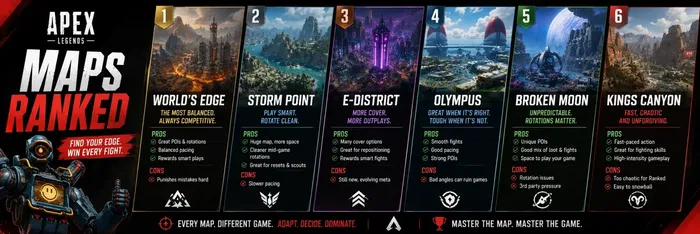
For Season 30 Split 2, which started on September 15, the Ranked map rotation is World's Edge, Olympus and Broken Moon. The midseason update confirmed the same maps for both Ranked and public matches. Map knowledge changes how Axle's mobility should be applied. For which Legends pair best with her on each map, see our guide to the best Legends for each ranked map.
World’s Edge
Buildings, vertical structures, and open transitions between points of interest give Axle many short- and medium-range movement options. Plan ability use around available cover rather than open ground whenever possible.
Olympus
Olympus mixes open areas with structured points of interest. Mobility helps the squad move between positions quickly, but open terrain still demands disciplined route selection. A poorly chosen gate across open space can expose the entire team.
Broken Moon
Longer rotations and varied elevation make mobility especially valuable for proactive positioning. The underlying principle remains constant across all three maps: use movement to reach a better position before you are forced to need it.
Axle’s Core Ranked Checklist
Before every aggressive engagement, run through this short checklist. It takes only a few seconds and prevents the majority of mobility-related ranked mistakes.
Before the fight
- Where are my teammates right now?
- Where are all three enemies?
- Do we already have a damage or numerical advantage?
- Is usable cover available on the route?
- Where is the next squad most likely to appear?
During the fight
- Can I create a useful off-angle?
- Is Nitro Gate actually improving my position or just making me faster?
- Can my teammates follow the play?
- Is Kickstart likely to produce immediate follow-up damage?
After a knock
- Do we push the remaining enemies or reset?
- Is another squad already approaching?
- Do we need to reposition before the next fight begins?
Before the next rotation
- Where is the next genuinely safe or strong position?
- Can Axle move the team there more safely than a standard path?
- Are we taking unnecessary fights simply because we can?
- Do we still have enough resources for the end game?
The Real Skill Ceiling of Axle
Axle’s mechanical ceiling is high, yet her strategic ceiling is higher still. Beginners ask how fast they can move. Intermediate players ask how the movement can help win the current fight. Advanced players ask a different question: how does this movement change what the enemy is allowed to do?
When movement is used correctly, you are not merely making yourself harder to hit. You are forcing the opponent into a decision. Do they turn toward you? Do they hold the original angle? Do they chase? Do they retreat? Do they expose themselves to the rest of your squad? Every purposeful movement option creates a response. High-level Axle players learn to anticipate and exploit that response.
That is the true strength of the Legend. Speed is only the delivery system. The real advantage is the decision the speed forces the enemy to make.
- Pathfinder Playstyle Guide: Master Movement and Grapples
- Apex Legends x Street Fighter 6 Event: Dates and Content
- All Apex Legends guides
Frequently Asked Questions About Axle in Season 30
Is Axle good in Apex Legends Season 30?
Axle remains a strong and flexible Skirmisher in Season 30, though Respawn has adjusted her kit to increase counterplay. Nitro Gate launch speed and Kickstart health, cooldown, knockback, and stun were reduced. Her effectiveness now depends heavily on timing, positioning, and disciplined decision-making rather than pure aggression.
After the 1 October nerfs she is A tier rather than S tier in our Split 2 tier list: strong in a squad that follows her engages, no longer a must-pick.
Is Axle good for Apex Legends Ranked?
Yes. Axle’s mobility, repositioning tools, and fight-disruption kit make her highly effective in ranked when used to support team positioning rather than justify isolated pushes. She excels at creating openings, rotating early, and converting damage advantages into positional pressure.
What is the best way to play Axle?
Play Axle as a controlled aggressive Skirmisher. Create damage first, use Nitro Gate or Kickstart to convert that advantage, and stay close enough for teammates to support you. Movement should solve a specific problem—never be used just because the cooldown is available.
Is Axle better for aggressive players?
Axle naturally suits aggressive players who enjoy movement mechanics and taking initiative. Her kit also supports defensive play through rotations, escapes, and repositioning. The best Axle players switch fluidly between aggression and control based on the situation.
What is the biggest Axle mistake?
The biggest and most common mistake is overextending because of superior mobility. Being able to reach an enemy does not mean your team can support you once you arrive. Always check team spacing and follow-up potential before committing.
What weapons work well with Axle?
SMGs such as the CAR, R-99, and Volt pair extremely well with close-range movement. Shotguns reward precise timing and positioning. Assault Rifles provide mid-range pressure that can be converted into a close-range finish with Nitro Gate. Choose based on your aim and preferred engagement distance.
What changed for Axle in Season 30?
Season 30 reduced Nitro Gate’s maximum slide-boost duration from five seconds to three, lowered launch speed from 750 to 700, reduced Kickstart health from 200 to 150, increased its base cooldown to 120 seconds, and lowered knockback and stun. Jump Gate was replaced by Drone Deployer, which restores the 90-second Ultimate cooldown.
The 1 October 2026 update went further: Drift lateral control down 50%, Nitro Gate lateral control down 25%, Nitro Gate push speed from 700 to 650, Kickstart knock-up from 700 to 650 and drone chase time from 10 to 8 seconds, and no aim assist while under Nitro Gate.
How should I use Nitro Gate effectively?
Treat Nitro Gate as a movement route, not a pure speed button. Use it to close a gap after creating damage, take an off-angle, rotate early, escape a third party, or help teammates reach better ground. Always create a reason to push before spending the ability.
When should I use Kickstart?
Use Kickstart when the enemy is isolated, already damaged, holding a predictable position, or trapped in a confined space, and when your team has line of sight and is ready to follow up. Avoid wasting it in tight geometry or without team coordination.
Is Axel the same as Axle?
The Legend’s official name is Axle. Some players search using the spelling Axel, so both terms appear in queries. This guide uses the official spelling throughout.
Final Thoughts: Master Movement, Not Just Speed
Axle is one of the clearest demonstrations in Apex Legends that movement can function as a strategic weapon. Her kit rewards players who understand momentum, spacing, timing, and positioning. The single most important lesson remains constant across every rank: speed is only valuable when it creates a measurable advantage.
A Nitro Gate that drops you into a 1v3 is not an advantage. A Nitro Gate that places the entire squad behind an enemy’s defensive angle can decide the fight. A Kickstart that nobody can follow up is limited value. A Kickstart that displaces a target while three teammates are ready to fire can completely rewrite an engagement. That distinction separates highlight-reel movement from effective ranked play.
Focus first on the fundamentals that never go out of date: position well, create damage before committing resources, move with clear purpose, stay connected to the squad, choose fights carefully, and reset quickly after every engagement. Master those principles and Axle becomes far more than a fast Legend. She becomes a reliable tool for controlling the pace of the entire match.
The Outlands rewards players who make better decisions faster. Axle simply gives you more ways to act on those decisions. Master the movement. Control the engagement. Climb Apex Legends Ranked.
This article is an independent informational publication. Apex Legends and related trademarks belong to Respawn Entertainment / Electronic Arts and their respective owners. Service availability, policies and pricing may change. Always review the current service page before ordering.