The best Legend for Ranked is not a universal pick. It depends on the map, your squad, your playstyle, and the problems the lobby forces you to solve. A kit that wins games on World’s Edge can underperform on Olympus or Broken Moon if it does not match how that map actually plays.
Map-by-map Legend picks at a glance
Match the Legend to the map’s biggest problems, not to a generic tier list.
- Current Ranked map pool
- How to choose the best Legend for a map
- Best Legends for World’s Edge
- Best Legends for Olympus
- Best Legends for Broken Moon
- Best Legend by Ranked map
- Universal Ranked Legends
- How map choice should change your pick
- Legend selection for solo queue
- Building three-Legend compositions
- Bloodhound rework and Catalyst value
- Improving beyond Legend selection
- Final recommendations by map
- Frequently asked questions
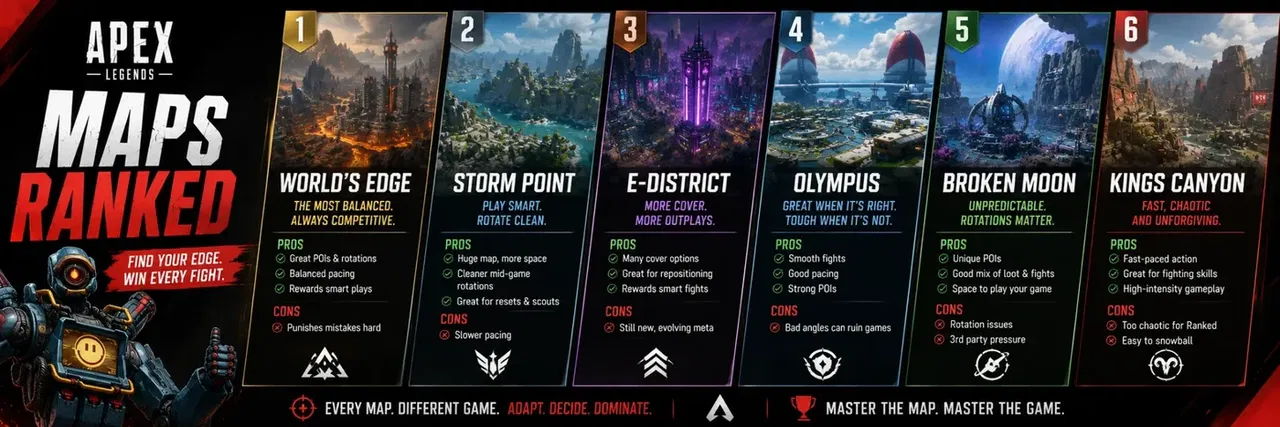
Current Apex Legends Ranked map pool
Before choosing a Legend, understand the current rotation. For Marked Split 2, the Ranked map pool is:
- World’s Edge
- Olympus
- Broken Moon
Respawn officially listed all three maps for Ranked beginning September 15, 2026. Storm Point and E-District left the main rotation for this split.
How to choose the best Legend for an Apex Ranked map
There is no single Legend that automatically guarantees more RP. The best Legend is the one whose abilities solve problems your team is likely to encounter on that map.
Legend choice is one piece of the climb; entry costs, RP and fight selection are covered in our Apex Legends ranked guide.
When evaluating a Legend, consider:
- Rotation — Can the Legend help your squad move between zones safely?
- Information — Can the Legend reveal enemy positions or provide useful tracking?
- Positioning — Can the Legend create or defend strong terrain?
- Fighting — Can the Legend help the squad start or finish fights?
- Survival — Can the Legend help the team survive a bad engagement?
- Endgame — Does the Legend become more valuable as the playable area gets smaller?
- Solo queue value — Can the Legend still provide value when teammates are unpredictable?
- Team composition — Does the Legend complement the other two members of the squad?
This is a much better way to evaluate a Legend than simply asking which character has the highest pick rate.
Best Apex Legends for World’s Edge
1. Bloodhound — Recon / Information / Fight initiation
Bloodhound is one of the most natural fits for the current World’s Edge environment because the Legend received a major rework specifically for Season 30.
Respawn redesigned Bloodhound’s kit around tracking and hunting. The updated Passive creates glowing enemy trails, White Ravens provide improved tracking utility, and the Tactical provides additional snapshot information. Bloodhound’s Ultimate was redesigned around a cloaking device that can temporarily conceal Legends inside its area.
World’s Edge has large POIs, complex buildings, vertical terrain, choke points, long rotations, multiple routes between areas, and dense fighting zones. Information becomes extremely valuable in these environments.
Bloodhound can help your squad answer:
- Where did that team go?
- How recently were enemies here?
- Are we being followed?
- Is the building occupied?
- Can we safely push?
Use information to make decisions—do not scan constantly without a purpose. Track, identify isolated targets, control engagement timing, then attack.
2. Catalyst — Area control / Defensive positioning / Endgame
Catalyst is another strong World’s Edge option because the map contains many buildings, doors, narrow routes, and defensible locations.
Catalyst received significant improvements during the current season, including a faster Tactical cooldown (reduced to 15 seconds), stronger Spike interactions, faster Ultimate deployment, and upgrade changes. Allies no longer suffer the previous slow or blind when passing through her wall.
Her kit can turn an ordinary location into a defensible position—especially important in late-game situations when the difference between open terrain and a controlled building can decide whether your squad survives.
World’s Edge often rewards teams that understand building control, door control, choke points, interior positioning, defensive resets, and endgame terrain. A good Catalyst player controls the areas where enemies need to move. A reinforced entrance can buy time to heal, reload, reset, swap armor, watch another angle, or prepare for a push.
3. Pathfinder — Mobility / Rotation / High ground
Pathfinder remains an excellent option for players who prefer aggressive mobility and map movement. World’s Edge contains many locations where vertical access and fast repositioning provide a meaningful advantage.
Pathfinder is especially useful when your squad wants to take high ground, rotate quickly, reposition after fights, escape unfavorable terrain, create aggressive angles, or reach buildings and elevated positions.
His greatest World’s Edge advantage is not simply movement speed—it is access. Being able to reach a position before another squad can change the entire fight.
For grapple technique, off-angles and Zipline Gun placement, see our Pathfinder playstyle guide.
4. Loba — Loot / Resource management / Rotation utility
Loba has also received improvements in the current season, including a reduced Black Market cooldown and a faster Tactical that covers more ground. This makes her useful for teams that prioritize resource consistency.
World’s Edge can produce long periods between major engagements. Reliable access to ammunition, healing, attachments, weapon upgrades, and utility can make a major difference. Loba is particularly useful for players who want a safer, more resource-focused Ranked experience.
Best World’s Edge team compositions
- Bloodhound + Catalyst + Pathfinder — Information, defensive control, mobility
- Bloodhound + Catalyst + Loba — Information, area control, resource management
- Pathfinder + Catalyst + Loba — Rotation, defensive positioning, loot efficiency
The correct choice depends on your squad’s playstyle.
Best Apex Legends for Olympus
Olympus is fundamentally different from World’s Edge. The map has large open spaces, long sightlines, elevated areas, rotational pathways, open terrain, strong vertical opportunities, and large gaps between important areas. Mobility becomes extremely valuable.
1. Pathfinder
Pathfinder is one of the most natural Olympus picks. His mobility helps teams cross difficult terrain, take high ground, and create unusual angles. Olympus frequently rewards teams that can reposition quickly. A squad that reaches strong terrain before another team can establish itself often starts the engagement with a major advantage.
Use Pathfinder to reach high ground, cross open terrain, escape bad fights, create unexpected angles, rotate between POIs, reposition after damage, and initiate aggressive plays. A Grapple should solve a problem. A Zipline should create an advantage.
2. Horizon — Vertical mobility / Team fighting / Positioning
Horizon is another strong option for Olympus because vertical movement is extremely valuable on open terrain. Her Gravity Lift helps teams access different elevations and create unusual attack angles.
Her value becomes obvious when a squad needs to change elevation quickly—for example, fighting from low ground against enemies on high ground. Horizon can help change the geometry of the fight. That is the real strength of vertical mobility.
3. Valkyrie — Rotation / Mobility / Repositioning
Valkyrie has historically been associated with map-wide rotation utility, and Olympus naturally rewards Legends capable of navigating large open spaces. She has also received balancing changes during the current season, so older guides may overstate her current strength.
Her value remains tied to rotation planning, escaping dangerous terrain, repositioning, taking alternate routes, and recovering from poor map positioning. For players who frequently struggle with late rotations, Valkyrie can still provide meaningful utility.
4. Bloodhound on Olympus
Bloodhound is not limited to World’s Edge. Olympus’ large areas make enemy information extremely valuable. Tracking enemy movement before crossing open terrain can prevent your squad from walking directly into another team.
This is particularly important because Olympus often provides fewer natural opportunities to disappear once a fight begins. If you cross an open area at the wrong time, you can become exposed from multiple directions. Bloodhound helps your squad make that decision with more information.
5. Conduit — Team sustain / Fight support
Conduit can be useful on Olympus because the map’s open spaces can create extended ranged engagements before a team commits to a full fight. Her ability to support teammates during combat can help maintain pressure without forcing an immediate retreat.
Conduit's recent history matters here. In the Season 29 midseason update, Respawn slowed her Tactical shield regeneration after her pick rate passed 10% and she appeared in 8 of the 10 most popular team compositions. The Marked midseason update on September 14 then gave her a faster Ultimate and new Level 2 upgrades. Treat her as a solid team-support choice for Olympus rather than an automatic pick.
Best Olympus team compositions
- Pathfinder + Horizon + Bloodhound — Mobility, vertical access, information (strong for aggressive squads)
- Pathfinder + Bloodhound + Conduit — Rotation, information, fight sustain
- Horizon + Bloodhound + Catalyst — Vertical movement, information, defensive control
The ideal composition depends on whether your squad prefers aggressive fights or controlled rotations.
Best Apex Legends for Broken Moon
Broken Moon emphasizes long rotations, Zip Rail movement, open terrain, long sightlines, large POIs, choke points, vertical areas, and rapid repositioning. Mobility and information are especially valuable. A squad that rotates efficiently can often arrive at a strong location before other teams.
1. Pathfinder
Pathfinder is a natural Broken Moon choice. The map’s geography rewards players who can take alternate routes and reach advantageous positions. His Grapple allows him to cross gaps, reach elevated terrain, escape pressure, create off-angles, and move between structures. Team mobility also helps a squad recover from bad positioning.
The most important concept is tempo. If another squad is already holding a strong position, your team does not want to arrive late and fight uphill. Pathfinder can help reduce the time required to reposition.
2. Bloodhound
Bloodhound is another excellent option because Broken Moon can create complicated movement patterns. Teams can approach from multiple directions. Enemies can disappear behind terrain. A squad can leave one POI and rotate toward another without being immediately visible.
Bloodhound’s tracking abilities can help reconstruct that movement. The current rework makes this especially relevant because the Legend’s identity is now strongly centered on tracking. A skilled Bloodhound player can turn enemy movement into information for the entire squad.
3. Alter — Mobility / Terrain manipulation / Escape
Alter can be valuable on maps where terrain and positioning create difficult situations. Broken Moon contains many locations where a squad can become trapped between teams or forced into unfavorable rotations.
Alter’s utility can help create alternate options when a normal rotation becomes dangerous. This is particularly useful in Ranked because a good escape route can prevent a negative RP game. Rather than viewing Alter exclusively as an aggressive Legend, consider her as a tool for creating options.
4. Catalyst
Catalyst can also be effective on Broken Moon. The map contains many locations where controlling entrances, chokepoints, and buildings can create strong defensive positions.
Current Catalyst changes make her particularly interesting for teams that want stronger building control. Her Tactical cooldown was reduced to 15 seconds in the September 2026 midseason patch, while her Ultimate became faster to deploy and no longer slows or blinds allies passing through it.
That makes Catalyst useful for holding buildings, blocking entrances, creating defensive resets, controlling late-game zones, and protecting healing windows.
5. Loba
Loba is useful when the squad values consistent resources. Broken Moon can involve long rotations and multiple engagements. A squad that arrives at the late game without ammunition, batteries, med kits, grenades, or attachments can be severely disadvantaged.
Loba’s improved Black Market and faster Tactical give her additional value for resource-focused teams. She is especially useful for squads that want to maintain combat readiness without spending excessive time looting.
Best Broken Moon team compositions
- Bloodhound + Pathfinder + Catalyst — Information, mobility, area control
- Bloodhound + Alter + Catalyst — Information, escape options, defensive positioning
- Pathfinder + Loba + Bloodhound — Rotation, resources, information
Best Legend by Ranked map
Here is a simple way to approach the current map pool:
| Map | Strong Legend choices | Main strength |
|---|---|---|
| World’s Edge | Bloodhound | Information and tracking |
| World’s Edge | Catalyst | Building and endgame control |
| World’s Edge | Pathfinder | Mobility and high ground |
| World’s Edge | Loba | Resource management |
| Olympus | Pathfinder | Rotation and vertical mobility |
| Olympus | Horizon | Vertical fighting |
| Olympus | Bloodhound | Information |
| Olympus | Valkyrie | Repositioning |
| Olympus | Conduit | Team sustain |
| Broken Moon | Pathfinder | Rotation and mobility |
| Broken Moon | Bloodhound | Tracking and information |
| Broken Moon | Alter | Escape and repositioning |
| Broken Moon | Catalyst | Area control |
| Broken Moon | Loba | Resource management |
This should not be treated as a permanent tier list. Apex Legends balance changes frequently, and Legend value can change after a single patch. For rankings built on high-elo pick and win rates, see our Season 30 ranked tier list.
The best universal Apex Ranked Legends
Although map-specific choices matter, some Legends provide useful abilities across almost every Ranked environment.
- Bloodhound — Information is useful on every map. The current rework centers the Passive and Tactical on tracking and enemy discovery.
- Pathfinder — Mobility is useful on every map. Reaching better terrain, escaping bad fights, and creating unexpected angles remain valuable regardless of the rotation.
- Catalyst — Defensive control becomes increasingly valuable as the ring gets smaller. A team that can protect its position has more options than a team forced to fight in open terrain.
- Loba — Resources matter in every Ranked game. Having the correct ammunition, healing, and attachments can determine whether a squad can take another fight.
What Master and Predator players pick in Split 2
Map fit and pick rate are different questions. The picks in this guide are about what each map rewards; this is what the highest-ranked players actually lock in across the Split 2 rotation, according to Apex Legends Status on 20 October 2026:
| Legend | Master and Predator pick rate |
|---|---|
| Pathfinder | 17.3% |
| Loba | 17.3% |
| Octane | 8.1% |
| Mad Maggie | 7.8% |
| Alter | 5.6% |
| Axle | 5.2% |
| Catalyst | 1.3% |
| Bloodhound | 0.3% |
Pathfinder and Loba are the only picks that are both a strong map fit and common at the top. Catalyst and Bloodhound are map-fit picks that most top squads still pass on, so they work best when your squad plays around them. The full ranking is in our Season 30 Split 2 tier list.
How map choice should change your Legend choice
A common mistake is selecting the same Legend every game without considering the map. Your first question in Ranked should be: What problem does this map create? Then select a Legend that helps solve that problem.
- World’s Edge — Complex buildings and defensive endgames → Catalyst (or Bloodhound for information)
- Olympus — Open terrain and difficult repositioning → Pathfinder or Horizon
- Broken Moon — Long rotations and complicated movement → Pathfinder or Bloodhound
This approach is more useful than blindly following a universal tier list.
How to choose a Legend for solo queue
Solo queue changes the equation. You cannot guarantee that your teammates will choose Legends that complement you. Therefore, individual utility becomes extremely valuable.
When solo queueing, prioritize Legends that can independently create value. Good questions include:
- Can I escape if teammates die?
- Can I rotate without relying on another Legend?
- Can I gather information?
- Can I create cover or defensive space?
- Can I recover from a bad position?
- Can I support teammates without perfect communication?
This is one reason mobility and information Legends can be especially comfortable for solo queue.
A practical solo-queue composition frame is Pathfinder + Bloodhound + Catalyst—even if teammates are unpredictable, those roles cover mobility, information, and position control.
How to build a three-Legend Ranked composition
A balanced squad usually benefits from three different categories of utility:
- Information — Someone needs to help the squad understand the battlefield (e.g. Bloodhound)
- Mobility — Someone should help the squad reposition (e.g. Pathfinder, Horizon, Valkyrie, Alter)
- Control or support — Someone should help the squad survive or maintain resources (e.g. Catalyst, Loba, Conduit)
Simple framework: Information + Mobility + Control/Support. It is not mandatory—aggressive squads can use different combinations—but it provides a useful starting point.
Aggressive Ranked compositions
Bloodhound + Pathfinder + Horizon — Information plus two mobility options. Helps identify enemies, close distance, create vertical angles, chase damaged teams, and escape bad engagements. The downside is less defensive control.
Placement-focused compositions
Bloodhound + Catalyst + Loba — Information, defensive control, and resources. Useful for teams that want to reduce unnecessary fights and focus on efficient rotations and strong endgames.
Solo queue compositions
Pathfinder + Bloodhound + Catalyst — Covers mobility, information, and position control so a solo player can contribute in every phase without perfect coordination.
How the current Bloodhound rework and Catalyst buffs change selection
Bloodhound
Season 30 significantly changed Bloodhound. The rework shifted the character toward a stronger tracker identity: the Passive leaves enemy trails, White Ravens have improved range, the Tactical provides additional snapshots, and the Ultimate creates a temporary cloaking area.
Older Bloodhound guides may not accurately describe how the Legend should be played today. The new design encourages players to think like hunters: track, gather information, identify isolated targets, control engagement timing, then attack. That philosophy fits Ranked particularly well.
Catalyst
The September 2026 update reduced Catalyst’s Tactical cooldown from 20 seconds to 15 seconds, improved Spike interactions, and made her Ultimate faster to deploy. Allies no longer suffer the previous slow or blind effects when passing through the wall.
These changes increase her ability to influence fights without making every engagement purely defensive. Catalyst can contribute to building control, fight initiation, door denial, retreats, endgames, rotations, and team resets—making her a particularly flexible Ranked choice.
Bloodhound's new kit, including Allfather's Cloak, is covered in full in our Season 30 patch notes.
How to improve your Ranked performance beyond Legend selection
Choosing the right Legend is only one part of climbing. You should also improve:
- Landing — Know your preferred POIs and nearby rotations
- Looting — Do not spend excessive time searching for perfect equipment
- Positioning — Always know where your team can retreat
- Fighting — Create advantages before committing
- Rotations — Move before the ring forces you to
- Communication — Share information instead of simply calling for pushes
- Endgame — Think about the next zone before it arrives
- Mechanics — Practice aim, recoil, movement, and weapon swaps
Choose a Legend based on your weakness
- If you die during rotations → mobility-focused Legend
- If you constantly get surprised → information-focused Legend
- If you lose endgames → area-control Legend
- If you run out of resources → resource-focused Legend
- If you struggle to escape → strong repositioning Legend
- If you struggle to initiate fights → Legend that creates advantageous engagements
This turns Legend selection into a training tool.
Best Apex Legends for each Ranked map: final recommendations
For the current Ranked map rotation, the strongest practical approach is to build around the map’s biggest strategic problems rather than selecting a Legend solely because a tier list calls it “meta.”
World’s Edge
Prioritize Bloodhound for information and tracking, Catalyst for defensive positioning and endgame control, Pathfinder for mobility and high-ground access, and Loba for resource management. World’s Edge currently has a refreshed layout with new and updated POIs, making map knowledge especially important.
Olympus
Prioritize Pathfinder for rotation and mobility, Horizon for vertical positioning, Bloodhound for information, Valkyrie for repositioning, and Conduit for team support. Olympus’ open spaces and vertical structure make mobility and positioning particularly important.
Broken Moon
Prioritize Pathfinder for mobility, Bloodhound for information, Alter for repositioning and escape options, Catalyst for area control, and Loba for resources. Broken Moon rewards teams that manage rotations and maintain strong positioning throughout the match.
- Apex Legends Ranked RP Guide: How RP Works and How to Climb Faster
- Apex Predator RP Cutoff and Pred Cap Guide
- Apex Legends Solo Queue to Master: The Complete Ranked Climbing Guide
- Apex Legends Fighting Fundamentals: How to Win More Gunfights
- How to Reach Apex Predator in Apex Legends | Ranked Guide
- All Apex Legends guides
Frequently asked questions
What are the best Apex Legends for Ranked?
There is no single best Legend for every Ranked map. Bloodhound, Pathfinder, Catalyst, Loba, and several mobility or support Legends can provide strong value depending on the current map and team composition.
What is the best Legend for World’s Edge?
Bloodhound and Catalyst are particularly useful for information and area control, while Pathfinder provides strong mobility. Loba is also valuable for resource-focused teams.
What is the best Legend for Olympus?
Pathfinder and Horizon are strong choices for teams that want mobility and vertical positioning. Bloodhound provides information, while Valkyrie can provide repositioning utility.
What is the best Legend for Broken Moon?
Pathfinder and Bloodhound are strong general-purpose options, while Alter, Catalyst, and Loba provide useful alternatives for mobility, area control, and resources.
Is Bloodhound good for Apex Ranked?
On the right map and in the right squad, yes. The Season 30 rework gave Bloodhound a faster scan and the Allfather's Cloak ultimate, which suits World's Edge and Broken Moon pushes. High-ranked players haven't adopted it, though: on 20 October 2026 Bloodhound was picked by 0.3% of Master and Predator players. Pick Bloodhound if your squad will use the scans and the cloak to start fights; otherwise Seer gives similar information with less coordination.
Is Catalyst good for Ranked?
Catalyst can be highly useful for teams that value defensive positioning and endgame control. Her September 2026 buffs improved several aspects of her Tactical and Ultimate.
Is Pathfinder good on every Apex map?
Pathfinder’s mobility can be useful across the entire Ranked map pool. His value is particularly high when a team needs to reach high ground, rotate quickly, or escape unfavorable terrain.
Should I use the same Legend on every map?
You can, but learning map-specific Legend choices can give you additional strategic options. If you understand multiple Legends deeply, adapting your selection to the map can improve team composition.
Are Apex Legend tier lists always accurate?
No. Tier lists can become outdated after balance patches, map changes, or changes to the Ranked environment. The current Season 30 patch cycle has already changed Bloodhound, Catalyst, Loba, Valkyrie, and other Legends.
Does Legend selection affect Apex RP?
Indirectly. Your Legend does not automatically give you more RP, but the right Legend can improve your team’s ability to rotate, fight, survive, gather information, and secure placement.
What Legends are best for Apex ranked boosting?
For a service focused on Apex ranked boosting, Legend selection should depend on the map, squad composition, player’s role, and current meta rather than using one fixed character. Experienced players should be able to adapt their Legend choice to the match.
What Legends are useful for Apex Pred boosting?
For Apex Pred boosting or high-level competitive play, flexible Legend selection becomes particularly important because small advantages in information, rotation, positioning, and endgame control can matter significantly. Predator is currently the top 750 Master-ranked players per platform.
Final thoughts
The best Apex Legend is not necessarily the character with the highest theoretical tier-list ranking. The best choice is the Legend whose abilities solve the problems created by the current map.
For World’s Edge, prioritize information, building control, and structured rotations. For Olympus, prioritize mobility, vertical positioning, and the ability to cross open terrain safely. For Broken Moon, prioritize rotation, information, and flexible positioning.
Most importantly, do not let the phrase “best Legend” make your decision for you. Learn why a Legend works. Understand where the abilities create value. Learn how the map changes your fights. Then adapt.
This article is an independent informational publication. Apex Legends and related trademarks belong to Respawn Entertainment / Electronic Arts and their respective owners. Before using any boosting service, review EA’s current Apex Legends rules on its official support site. Service availability, policies and pricing may change, so always check the current service page before ordering.